Lenti Acustiche
(Horns: Compression drivers
http://education.lenardaudio.com/en/07_horns_2.html )
For circular and near circular horns a lens
was the most effective means to increase
horizontal dispersion without introducing
lobe distortion and minimal loss of efficiency. An acoustical
lens is the equivalent of the optical lens.
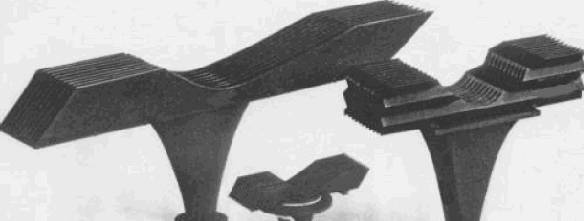
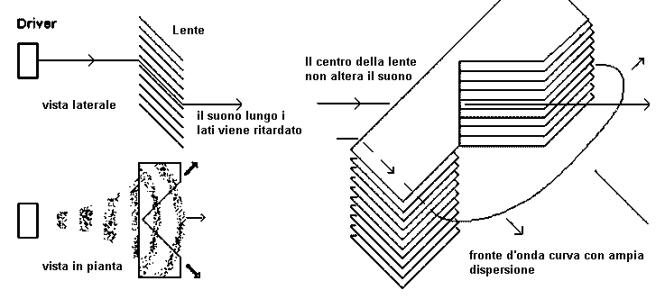
A labyrinth of concave plates is put in front of the horn. Sound from
the centre of the horn passes
through unhindered. Sound to the sides of centre in the horn, pass
through the lens labyrinth, increasing
the distance traveled and delayed in time. The sound waves are bent
forming a wide horizontal
dispersion. The lens improves horizontal dispersion as the frequency
increases.
The lens is no longer used. It is large, fragile and expensive. Economic
rationalism, not technical
performance was and still is its downfall. Also the lens function was
not well understood. Its physical
appearance does not give an intuitive understanding of its function. Many
old 60s - 70s roadie sound
engineers believed the lens directed sound downward to the audience
sitting in the front row. The lens
was commonly referred to as a waterfall effect speaker. Ignorance and
miss-understanding was and
still is a problem throughout the professional audio industry.